Keeping the Economy Afloat
![]() |
Emerging economies face capital outflows. Between 2009 and 2011, low interest
rates in developed economies sparked massive flows of hot money into emerging
economies. The hot money fueled asset inflation and spiced up economic growth
too. The latter gave the perception of emerging economies decoupling from
developed ones and incited even more inflow. The asset inflation eventually
sparked general inflation, which slowed economic growth and diverted money from
asset markets. The resulting asset deflation further decreases economic growth.
Hot money is now leaving because it sees the unsustainability of the growth
dynamic in emerging economies.
The Indian rupee and Brazilian real
have declined by one-fifth from their recent highs, reflecting pressure from
capital outflows. Because China has a controlled exchange rate, the outflow has
come later, as investors believed in the safety of a government-supported
exchange rate. The weakening economy this year appears to have sparked
expectations of yuan depreciation. The government support of the exchange rate
has become an accelerator for capital outflow, as it is increasingly viewed as a
subsidy for early leavers.
China's banking system is supporting the
property market through rolling over loans for delinquent property developers.
It distorts the price in a market with sales of 13 percent of GDP last year.
This force is another subsidy for capital outflow, as developers cut sales to
slow price declines. Because a large share of hot money has landed in the
property market, the banks are effectively subsidizing its liquidation value.
This subsidy is encouraging capital outflow too.
The sum of trade
surplus, foreign direct investment and the decline of forex reserves totaled US$
164 billion in the second quarter. It is a crude approximation of capital
outflow. It doesn't include the interest accrual on the stock of forex reserves,
which could add another US$ 30 billion to the sum.
The macro data
are consistent with anecdotes on the ground. The difficult operating environment
and uncertain outlook are prompting businessmen to emigrate en masse. Gray
income appears to be looking for safety offshore. China's broad money supply is
93 trillion yuan, 4.5 times the forex reserves. In addition, there are
considerable monetary assets outside of the formal banking system exceeding
forex reserves too. The vacant properties alone could exceed forex reserves in
today's value. The potential for a run on the forex reserves is
significant.
Even though China's capital account is not open, there
are many ways to take the money out. In 1998, for example, much of the decline
in forex reserves could be attributed to over-invoicing or non-delivering
phantom imports. Underground channels are well developed today. Macau's casino
proceeds are four times Los Vegas'. The potential for capital flight through
Macau is significant. A new channel is to acquire offshore assets funded by
domestic loans with domestic assets as collateral. The capacity of capital
outflow under the current system may considerably exceed US$ 100 billion per
month.
Learning from the Asian Crisis
There are similarities between China today and Southeast Asia fifteen years
ago. China could learn from the latter's experience and control the financial
risk in today's uncertain environment.
Between 1992 and 1996 the
low U.S. interest rate prompted a massive amount of hot money to flow into
Southeast Asia. The money was mainly lent to the region's banks, which lent the
money out for investment in commodity industries and property speculation. The
tide reversed in 1997. It triggered massive devaluation and economic
contraction.
When faced with capital outflow pressure, Southeast
Asian countries used their forex reserves to defend the exchange rates. Like
China today, they had controlled exchange rates. They had plenty of forex
reserves when the outflow pressure began. But, after defending the exchange
rates for an extended period of time, they couldn't back down from the policy
until depletion of the forex reserves forced them to devalue. Some countries
even borrowed considerable amounts from the International Monetary Fund to
continue the wrong policy. All they achieved was subsidizing capital flight.
Without forex reserves, these countries couldn't support their
financial systems. The financial collapse brought massive economic contraction
and widespread suffering. If these countries had floated their currencies at the
first sign of outflow pressure, they wouldn't have suffered as much.
The irrational, costly and sustained defense of fixed exchange rates had much to do with who was taking money out. It was the ruling elite taking their gray income out. This political force may partly explain why these countries were so resolute in defending their exchange rates.
Float the Yuan Now
China's forex reserves are massive in absolute amount. But they cannot really
be all deployed. If the forex reserves fall by one-fifth, it may trigger panic.
China's monetary assets are many times the forex reserves. A panic could exhaust
the reserves quickly. Even if the government institutes tougher capital control
to slow the outflow, as what occurred in 1998, the resulting confidence collapse
could do considerable damage to the banking system.
When Southeast
Asian countries lost their forex reserves, their governments had little
credibility to revive their banking systems. It was a factor in their economic
suffering. They had to keep exchange rates extremely low to earn foreign
currencies to reflate their economies.
Despite some revival in
property sales in May and June, China's property market is in a multiyear
adjustment. This dynamic casts a long shadow over the country's banking system.
Credit expansion has been largely dependent on land appreciation. In an
investment-led growth strategy, returns on capital are low. Hence, credit
expansion depends on collateral rather than business cash flow. Because land is
the dominant form of collateral, land appreciation and rapid credit expansion
have been mutually supporting each other in the past decade, which had been in
bubble territory for at least five years. When this dynamic runs its course, the
reversal could severely damage the banking system.
Chinese bank
stocks are very cheap. Even the low prices reflect the market's hope for
government support at some point. The faith in the government depends on the
large forex reserves, which lends credibility to the government's financial
power. The market's faith in the government's financial power is the anchor for
China's financial stability. Otherwise, a full-blown financial crisis would have
occurred.
China should float the exchange rate now and lock away
its forex reserves. The commitment to not buying or selling dollars by the
central bank will remove a big risk to the country's economy. It was a big
reason for the inflow of hot money and, hence, a big contributor to the bubble.
It has been a contentious point in China's economic relationship with the West.
In one stroke, the country could remove this irritant in the domestic economy
and international relationship. Of course, it safeguards the government's
credibility in supporting the financial system.
Investment
May Rebound …
Beijing's policies for growth stabilization rely on pump-priming investment
projects. Despite the economic slowdown in the first half of 2012, total net
fund-raisings increased by 1.7 percent to 7.78 trillion yuan (34 percent of GDP
in the same period), and broad money increased by 13.6 percent compared to an 11
percent increase in nominal GDP. While the perception is that the downturn is a
result of policy tightening, the facts speak otherwise. Liquidity and financing
conditions are quite loose. The economic downturn results from the property
bubble bursting under its weight, not really from any policy
push.
The cash shortfalls are mainly in property and land sales.
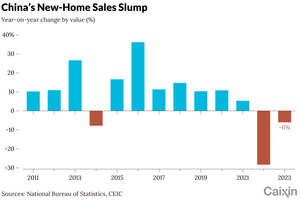
The two are related. Last year, property sales were 15 percent of GDP and land
sales 6 percent. The official statistics say property sales declined by 10
percent in the first half. As property sales are often booked with a lag and
many developers had cashless sales this year, the real shortfall is much
greater. I wouldn't be surprised that the real shortfall there exceeded 1
trillion yuan in the first half of 2012.
While statistics are spotty, it is fair to say that land sales collapsed in the first half. China's property industry profits from land appreciation, not from developing property per se. When the price of land is declining, developers won't have money to buy land. While property sales can be sustained through cutting prices, land sales cannot.
The cash shortfall for investment due to property market adjustment could be 3 to 5 percent of GDP. It is a big number but could be mostly offset by the increase in fund-raising elsewhere. For example, local government funding vehicles are on the move to raise more money. The corporate bond market is likely to grow quicker in the second half. It appears that investment may rebound in the second half.
… But Confidence Won't
China experiences overcapacity in most industries. Rising costs have further
weakened businesses' ability to earn profits. The economy has been
disproportionately dependent on land appreciation as the source of profit. From
banks to loan sharks, the financial sector is highly dependent on land
appreciation for sustaining lending margins. Commodity industries have been
subsidized by commodity traders who earn profits from loan-sharking to property
developers. Equipment suppliers depend on local governments' ability to pay.
That depends on land sales. Of course, this model of sustaining profitability is
a bubble. As the bubble bursts, profitability will be squeezed all around.
Sustaining investment through increasing other sources of financing won't change
this story.
When businesses see shrinking profitability, they are
likely to shrink businesses. If there is no hope for any profitability, they may
liquidate and, in many cases, emigrate. In addition to declining profitability,
businesses also feel the squeeze from local governments that try to increase

revenues elsewhere after losing most land sales. That squeeze is frightening. It
has the potential to squeeze out all the past profits of the existing
businesses. So for many closing down and leaving is the best
option.
Structural Reforms
Business confidence ultimately depends on the prospect of making a profit.
Land inflation worked for a while. But, it was just a bubble. Profitability
ultimately depends on a rational balance between consumption and investment. The
government manages the economy by pushing investment. Investment-led growth
inevitably leads to overcapacity, low profitability and bad loans. The
investment push can be stretched by creating a bubble, i.e., investment
profiting from investment. When such a bubble bursts, the financial system is
inevitably saddled with tremendous bad debts.
China has serious
legacy costs from the property bubble bursting. If the policy is to cover up the
fallout, for example, extending loans to delinquent borrowers forever, the
economy could become like Japan's after its property bubble began to deflate in
1992. Unlike Japan, China has the chance to grow. The per capita income in 2012
is likely to be US$ 6,000. It is about 15 percent of the Organization for
Economic Co-operation and Development level. If China improves productivity, the
pie could grow sufficiently to dwarf whatever financial costs the deflating
bubble may inflict.
As I have written numerous times before, China
needs to cut taxes and shrink government spending to boost consumption and
incentivize businesses to improve technology and quality. The latter needs China
to have proper cost of capital. The low interest rate in the past decade has
incentivized businesses to focus on speculation rather than technology or
quality. Cutting taxes can decrease the national savings rate, which boosts the
cost of capital and eliminates excess capacity.
If China wants to

incentivize businesses and households to keep money at home, the government
should cut taxes substantially and shrink the state sector with numerical
targets and timetable. Otherwise, capital outflow is likely to


continue.
The author is a board member of Rosetta Stone Capital
Ltd.
- Shanghai's Design, Art & Fashion Fair
- Art Basel Hong Kong
- Game of Soft Power
- Debate Erupts after Mercury Found in Chinese Medicine
- In Friday's Papers: NDRC Denies Reports of Urbanization Conflict, County Boss in 3.7 Mln Yuan Bribe Case
- Tiny Sidewalk
- Moveable Dwelling
- World Top 50 Most Marketable Athletes: 8 Brits, 0 Chinese
- A Hole in China's Skyline
- Patriarch Kirill's China Mission
- Sign up to receive our free daily newsletter
- Too Big To Fail Is Bigger than Ever
- Marriage, Sex and Character
- Playing the Long Game
- China's Open Source Hardware Movement
- Teams to Draft Reform Topics for Party Congress Set up
- Alibaba Intending to Dig Deep for E-commerce Gold
- Honeymoon's Over for Sweethearts of SOE Reform
- The Time for Rate Reform Is Now
- In Thursday's Papers: Commercial Banks ‘Made 4.1 Bln Yuan A Day,' Officials Who Secretly Taped Boss Arrested
- What Xi's Travel Itinerary Says about China's Foreign Policy